REVIEW · NEW DELHI
Half-Day Delhi Temple Tour with Pick-Up & Drop-Off
Book on GetYourGuide →Operated by Go City Adventures · Bookable on GetYourGuide
Delhi temples in one tight route can be powerful. This half-day tour strings together major faith sites across Hinduism and Sikhism, plus the Bahá’í Lotus Temple, with a guide helping the symbols make sense. You’re also set up with a comfortable air-conditioned ride and timed stops that keep the day from dragging.
I especially love the mix of places that feel different in tone: the calm geometry of the Lotus Temple, then the devotional energy at ISKCON and the big ceremonial scale at Akshardham. Another strong point is Gurudwara Bangla Sahib, where the community kitchen experience adds a human side to all the religious art and architecture.
One drawback to consider: the quality of the day can depend heavily on the guide’s depth. In the feedback I reviewed, one person felt the guide acted more like a chaperone and the information was thin, so I’d plan to ask questions and confirm you’ll get real explanations rather than just logistics.
In This Review
- Key takeaways before you go
- Price and value for a $31 guided temple circuit
- How the pickup and AC ride shapes the whole day
- Lotus Temple: the Bahá’í welcome mat for your temple day
- ISKCON and Krishna: devotion you can feel
- Akshardham: the world’s largest Hindu temple complex and its big stagecraft
- Gurudwara Bangla Sahib: the community kitchen you’ll remember
- Prachin Hanuman Mandir near Connaught Place: older roots, quieter awe
- Laxmi Narayan Temple (Birla Mandir): a major finish with lots of shrines
- Guides, shoes, and the stuff that decides if this feels great
- Optional add-ons that can change the day a lot
- Who this tour suits best (and who might feel cramped)
- Should you book the Half-Day Delhi Temple Tour?
- FAQ
- How long is the Half-Day Delhi Temple Tour?
- What pickup areas are available?
- Which temples and stops are included on the main route?
- Do I get a guide, and what languages are offered?
- Are meals included?
- Are entrance tickets included?
- Is the Akshardham light and water show included?
Key takeaways before you go
- Lotus Temple and its Bahá’í symbolism: a lotus-shaped landmark and one of the few major Bahá’í sites in the region
- Akshardham scale plus a night finale: a huge temple complex, capped by the light and water show
- Bangla Sahib’s langar (community kitchen) spirit: a moving stop that goes beyond sightseeing
- Old Delhi-adjacent depth without the chaos: older roots at Prachin Hanuman Mandir near Connaught Place
- Shoe rules are real: shoe-keeping is included, but you’ll still want to be ready to remove footwear
- Time is tight on a 5–7 hour day: you’re hitting several major sites, so you’ll want comfortable patience
Price and value for a $31 guided temple circuit
At around $31 per person, this tour is priced like a value-focused “see a lot with less hassle” option. You’re not paying for a pile of ticketed attractions. Instead, the cost mainly covers the guided route, hotel pickup/drop-off, and the air-conditioned transport between stops.
Here’s the best way to think about value: many of these temples are free to enter (even when the complex is impressive), so the guide and the sequencing matter. If you like your travel with context—why a place looks the way it does, what a ritual or symbol means—then this format tends to feel worth it. If you prefer to wander with zero structure, you might feel boxed in by timing.
You can also read our reviews of more tours and experiences in New Delhi

How the pickup and AC ride shapes the whole day
The day starts the way Delhi days should start: with hotel/area pickup across New Delhi, Delhi, Noida, Gurugram, and Ghaziabad, then return to drop-off points in the same set of cities. That matters because traffic can eat half your energy before you even reach the first temple.
The transport is air-conditioned, which is a big deal when you’re doing multiple outdoor-heavy stops. You’ll also get a guide who keeps you moving and explains what you’re seeing, which helps a lot when you’re bouncing between different faith traditions and architectural styles.
If you’re picky about scheduling, know the tour can run about 5–7 hours depending on the option chosen. That range usually means you may spend more time on certain sites or extensions.
Lotus Temple: the Bahá’í welcome mat for your temple day
Your first major stop is the Lotus Temple, famous for its lotus-shaped design and peaceful gardens. Even if you’re not deeply familiar with Bahá’í beliefs, the place itself does the teaching. The architecture gives you calm right away—order, symmetry, and a sense of quiet that feels intentional.
You’ll get a guided visit for about 30 minutes. That’s a short window, but it’s enough time to understand why the temple is admired worldwide and to notice how the design supports contemplation. It’s also a helpful “warm-up” before you switch gears to more overtly devotional spaces like ISKCON.
Practical note: this is one of those places where walking slowly beats rushing. If you’re the type who likes to stand back, watch people, and read the room, you’ll enjoy Lotus most.
ISKCON and Krishna: devotion you can feel
Next up is ISKCON Temple, dedicated to Lord Krishna. Compared to the Lotus Temple’s calm geometry, ISKCON tends to feel more expressive and devotional. Think of it as a shift from contemplative quiet into something more communal and energetic.
Your guided time here is about 40 minutes, which is just right for moving through key areas without feeling lost. A good guide helps you translate what you’re seeing into terms that make sense quickly—what this space represents, why it attracts visitors, and how it fits into the broader Hindu devotional world.
This stop is also a nice contrast to what comes later at Akshardham. Together, they show you two very different ways Hindu devotion can show up in public space: one grounded in temple worship and community practice, the other in a massive, carefully designed complex.
Akshardham: the world’s largest Hindu temple complex and its big stagecraft
Akshardham is the heavy hitter. This is described as the world’s largest Hindu temple complex, known for intricate carvings and cultural exhibits. In plain terms: you’re looking at an entire universe of stonework and storytelling, not just one building.
You’ll get about 1 hour with a guide. That’s enough time to appreciate the detail and get oriented, but it also means you should avoid thinking you’ll see everything. The goal here is understanding the themes and enjoying the scale, not trying to complete a full self-guided marathon.
Then comes the evening finale: the Akshardham light & water show. This is where the complex’s stories are meant to play out visually. If you like religion presented as art, performance, and symbolism, this is one of the best parts of the day because it turns architecture into narrative you can feel.
Timing tip: if the day feels packed, this is where you’ll want a clear head. The show can be long enough that you’ll be glad you didn’t burn energy earlier.






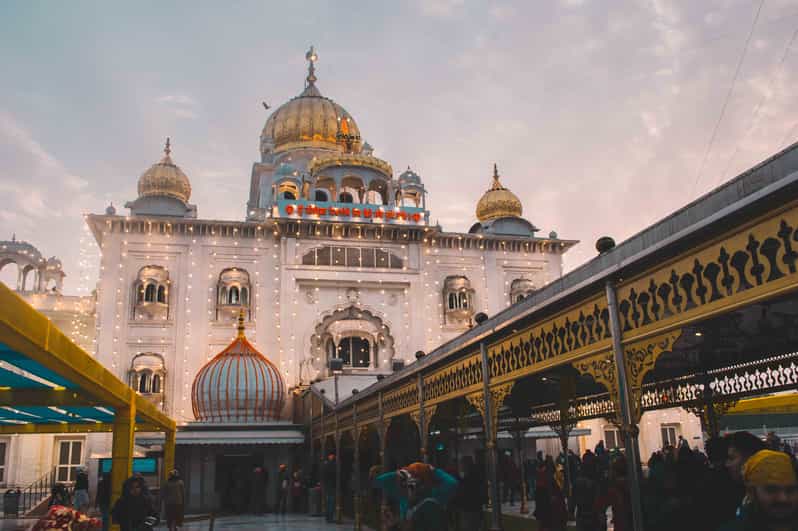
Gurudwara Bangla Sahib: the community kitchen you’ll remember
Gurudwara Bangla Sahib is Delhi’s prominent Sikh temple and one of the stops that tends to land emotionally. You’ll have guided time of about 35 minutes, which includes time to take in the space and understand its meaning in Sikh life.
What makes this stop special is the focus on community kitchen and service. Even if you don’t fully know Sikh traditions beforehand, the idea is easy to grasp: this is religion put into action, not just decoration. In the feedback I saw, the community kitchen experience was described as once-in-a-lifetime, and that reaction makes sense. It’s the kind of visit that shifts you from watching to participating in spirit.
Also, because Sikh spaces are built around welcome, this can be a great “human reset” halfway through a temple-heavy route. After big monuments and formal temple architecture, Bangla Sahib brings the day back to people.
Prachin Hanuman Mandir near Connaught Place: older roots, quieter awe
After Bangla Sahib, the tour moves to Prachin Hanuman Mandir in Connaught Place, with guided time around 30 minutes. This temple is described as one of Delhi’s oldest, with roots tracing back to the Mahabharata era.
That “old roots” angle is more than trivia. When you visit a site that connects to ancient epic traditions, you’ll notice how many modern religious practices still grow from the same symbolic trees: devotion, protection, and the idea of Hanuman as a figure tied to strength and devotion.
This stop can feel calmer than the biggest complexes. That’s a good thing. It gives your brain a breather and helps the day feel like a journey across time rather than a checklist of sights.
If you’re into photo stops, this one can be a good candidate because the scale tends to be more intimate. If you’re not into photos, you can still enjoy it by listening—temples like this make the guide’s interpretation especially useful.
Laxmi Narayan Temple (Birla Mandir): a major finish with lots of shrines
The last big temple on the main route is Laxmi Narayan Temple, also known as Birla Mandir. You’ll get about 40 minutes with a guide, and the complex is described as dedicated to Lord Vishnu, with shrines for Buddha, Ganesha, and Laxmi.
This makes it a helpful closing stop because it shows a layered spiritual layout. You’re not only seeing one deity focus. You’re seeing how different aspects of religious life can share a single sacred space, which can make the day’s mix of traditions feel more connected rather than scattered.
By the time you reach this temple, you’ll probably have a stronger sense of what you care about: architecture, symbols, rituals, or the emotional tone of worship. Birla Mandir is a strong “final impression” because it’s designed for visitors to take it all in at once.
Guides, shoes, and the stuff that decides if this feels great
A guided temple tour is only as good as the guide. In the feedback I reviewed, Suraj was highlighted as a strong guide, with special praise tied to the Sikh temple experience and the meaning behind it. That kind of guiding turns a short stop into something you can actually process.
On the flip side, one person felt the guide was more of a chaperone and didn’t provide enough information—like they skipped the chance to explain what you were seeing after Akshardham. That’s why I recommend you bring one mindset: you’re not just getting transported. You’re buying explanations.
Also: shoe rules. The tour includes a shoe-keeping fee, which strongly suggests you’ll remove footwear at some point. Don’t show up in fancy shoes you hate taking off and re-walking in. Comfortable slip-on items, socks you don’t mind, and a small bag you can manage makes the experience feel smoother.
Finally, keep an eye on pacing. A 5–7 hour day with multiple major sites means you’ll have limited wandering time. If you want longer, slower temple visits, consider pairing this with one deeper area on a separate day.
Optional add-ons that can change the day a lot
This experience can be combined with other temple-focused options, including versions that connect to Old Delhi areas or a Gandhi’s Journey in Delhi theme, as well as an extension that highlights the Akshardham light & water show more centrally.
If you choose Old Delhi-related add-ons, pay attention to what’s not included. The notes say entry tickets to Jama Masjid are not included. So you’ll want to plan your budget for any added ticketed stops if your chosen option pulls you into Old Delhi’s major landmarks.
Who this tour suits best (and who might feel cramped)
This tour is best for you if:
- You want a short, structured temple introduction across Hinduism and Sikhism, plus the Bahá’í Lotus Temple
- You’re new to Delhi and want pickup/drop-off to reduce stress
- You like learning the meaning of places, not just walking past them
You might think twice if:
- You strongly dislike timed schedules and short guided windows
- You expect deep, hour-long temple study at each stop
- You’re looking for a very personal, unhurried experience rather than a route
And one more reality check: because many sites are free to enter, you’re paying for guide time and transportation. If you don’t get value from narration, the price might feel less satisfying.
Should you book the Half-Day Delhi Temple Tour?
Book it if you want a smart first pass at Delhi’s spiritual landmarks with a guide who can translate symbols into meaning—especially if the Akshardham light & water show and the Gurudwara community kitchen are on your must-see list.
Skip or rethink it if you’re the type who hates shoe-removal logistics, gets impatient with multi-stop pacing, or you know you need very detailed explanations at each site. In that case, you may do better with a more focused tour that spends more time at fewer places.
FAQ
How long is the Half-Day Delhi Temple Tour?
It runs about 5 to 7 hours, depending on the option you choose and the starting time availability.
What pickup areas are available?
Hotel pickup is available across New Delhi, Gurugram, Noida, Delhi, and Ghaziabad, with drop-off also offered in those same areas.
Which temples and stops are included on the main route?
The main stops include Lotus Temple, ISKCON Temple, Akshardham, Gurudwara Bangla Sahib, Prachin Hanuman Mandir, and Laxmi Narayan Temple (Birla Mandir).
Do I get a guide, and what languages are offered?
Yes. The tour includes an English/language tour guide, with languages listed as English, Spanish, German, Italian, and French.
Are meals included?
No. Meals and drinks are not included.
Are entrance tickets included?
Entry tickets to Jama Masjid are not included. (The tour notes also mention a Rickshaw Ride in Old Delhi is not included, which matters for certain add-on options.)
Is the Akshardham light and water show included?
Yes. The experience description includes an evening Akshardham light & water show as the finale.