REVIEW · AGRA
Agra Fort: Guided UNESCO Heritage Walking Tour
Book on GetYourGuide →Operated by Crystal India Holidays · Bookable on GetYourGuide
One hour can feel like a whole reign. Step into Agra Fort on a UNESCO heritage walking tour that moves from monumental gates to palace halls and prison stories. You’ll follow a guide through the key Mughal spaces and leave with a clearer sense of how this place worked—military muscle and royal theater at the same time.
What I love most is the way the tour connects specific rooms to what was happening politically—especially the shift from public court spaces like Diwan-i-Am to private audiences in Diwan-i-Khas. I also like that guides such as Gagan and Shahid Khan don’t just talk history; they help you get better photos and stay on track, even when the entrance area gets chaotic.
The one catch is practical: the fort is huge, the surfaces can be uneven, and you’ll do a lot of walking for a 1-hour window. Wear comfortable shoes, and expect some bag checks before you get inside.
In This Review
- Key highlights to look for
- Entering Agra Fort From Amar Singh Gate
- Diwan-i-Am to Diwan-i-Khas: Mughal power in plain sight
- Jahangiri Mahal and the court-palace blend
- The prison story: where Aurangzeb held Shah Jahan
- Musamman Burj: bittersweet views and a final setting
- Mirrored palace and Anguri Bagh: geometry you can actually see
- Photo tips that your guide will help with
- Pace and comfort: a big fort in one hour
- Price and value: why $6 makes sense (and when it doesn’t)
- Meeting your guide smoothly (WhatsApp helps)
- Best for: who should book this
- Should you book the Agra Fort guided UNESCO walking tour?
- FAQ
- How long is the Agra Fort guided tour?
- Where do I meet my guide?
- What’s the price of the tour?
- What’s included in the price?
- Are transfers included?
- What languages are the tour guide available in?
- What should I bring?
- Is photography allowed?
- Is the tour private?
Key highlights to look for
- Amar Singh Gate entry: your official starting point and best way to get oriented fast
- Diwan-i-Am to Diwan-i-Khas: see how Mughal audiences worked, from public court to private access
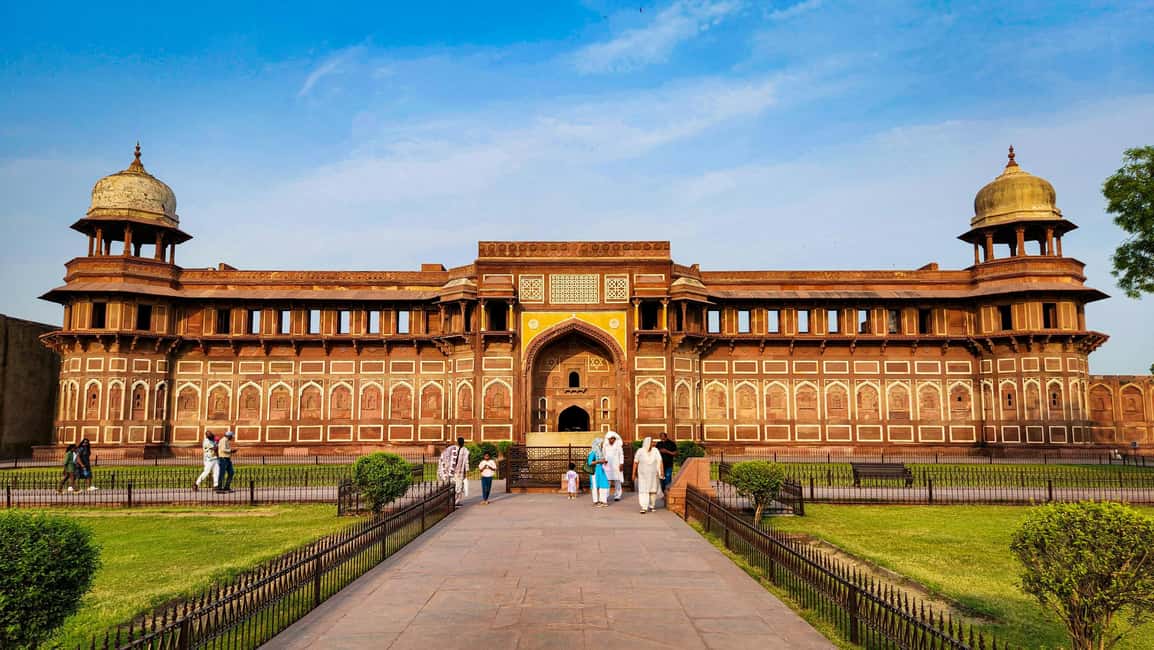
- Jahangiri Mahal and mirrored palace: palace design details you’ll actually notice once someone points them out
- Shah Jahan’s imprisonment story: you’ll visit the spot connected to Aurangzeb’s hold on power
- Musamman Burj and Anguri Bagh: court drama gives way to a view-minded finale with geometric garden layouts
- Guides who help with photos and crowd flow: including photo assistance and avoiding vendor hassle
Entering Agra Fort From Amar Singh Gate
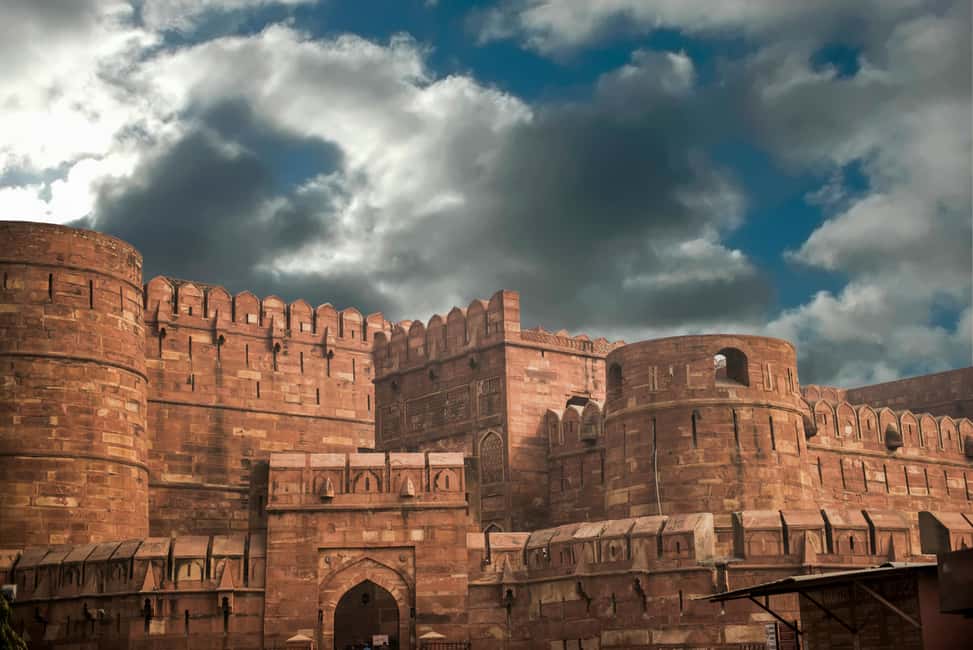
Agra Fort is one of those places where “wandering” is easy—but understanding is harder. This tour fixes that by starting you at Amar Singh Gate, the main entry for visitors. From the first minutes, your guide is setting context: this fort wasn’t built to look pretty for tourists. It was designed to control territory and stage royal life, often at the same time.
You’ll walk along ramparts and through grand gate approaches, and that physical movement matters. You start to feel the scale of the fort—how it could protect a capital and how emperors could move between power spaces without leaving their world behind. Even if you’ve seen photos online, the fort’s layout becomes clearer when someone points out how the structure supports both defense and ceremony.
You can also read our reviews of more walking tours in Agra



Diwan-i-Am to Diwan-i-Khas: Mughal power in plain sight

One of the best parts of this experience is the practical route through the audience spaces. You’ll get to Diwan-i-Am, the Hall of Public Audience. Even without deep jargon, the room teaches you how rulers communicated: it’s a setting built for visibility, order, and public-facing authority.
Then comes Diwan-i-Khas, the private audience hall. The contrast is the point. You’ll be looking at architecture, but you’ll also be absorbing the idea that the Mughal court ran on different layers—public performance for subjects and controlled, selective access for more intimate matters. This is where a good guide changes the experience from sightseeing into “I get it” history.
You’ll also notice Mughal design language as you move: arches, jharokhas, marble carvings, and the kind of detailed stonework that rewards a slower look—exactly what you don’t get when you rush on your own.
Jahangiri Mahal and the court-palace blend
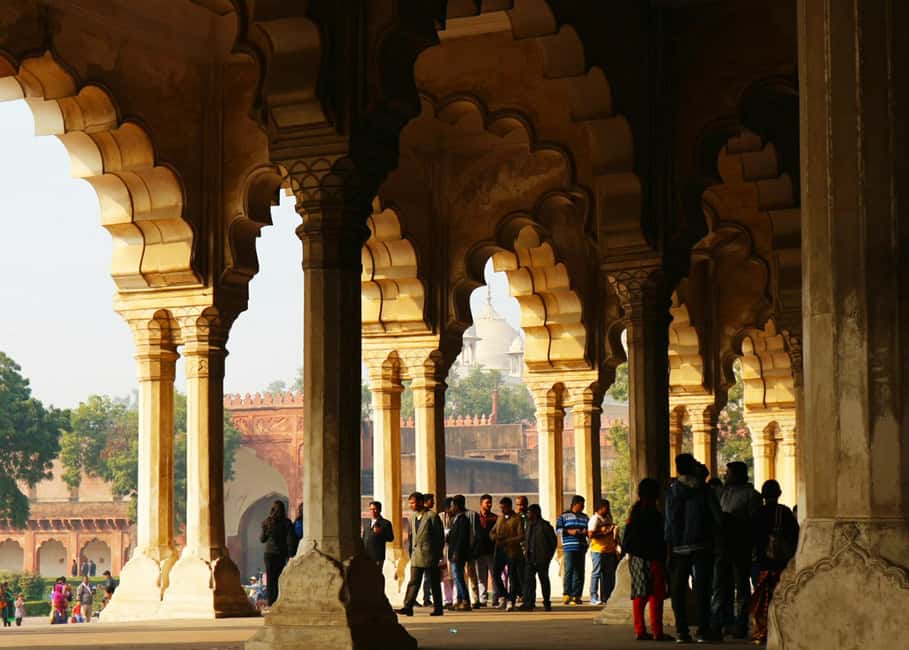
After the audience halls, you shift into palace territory with stops that show how Agra Fort worked as a residence, not just a fort. Jahangiri Mahal is a highlight here, and the tour frames it as part of the Mughal taste for comfort and status, even inside defensive walls.
This section matters because it connects the artistic choices to the politics. The fort’s palaces blend influences—Rajput, Persian, and Islamic styles—so you’re not only seeing Mughal architecture. You’re seeing how a ruling culture borrowed, adapted, and used aesthetics to signal legitimacy.
If you’re the type who likes to understand why buildings look the way they do, this portion gives you “handles” for interpreting the details. And you’ll likely start spotting patterns on your own as you move—windows, balconies, carved surfaces—things you’d normally pass by.
The prison story: where Aurangzeb held Shah Jahan
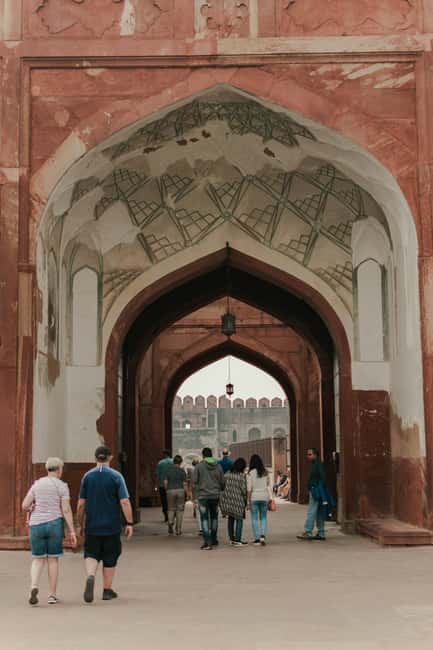
Agra Fort is famous for grand spaces, but it’s also tied to tense family power. This tour takes you to the spot connected with Shah Jahan’s imprisonment by Aurangzeb, a storyline that changes the mood of your walk.
Even if you already know the broad Mughal timeline, seeing the connected location within the fort gives the story weight. You start thinking differently: instead of only imagining battles in the abstract, you picture the control—who could move, who could speak, and where an emperor’s world narrowed.
From a visitor’s standpoint, this is one of the most meaningful parts of the tour because it anchors the drama to real stone. It also helps you connect later stops, especially when the walk turns toward Shah Jahan’s final days.
Musamman Burj: bittersweet views and a final setting
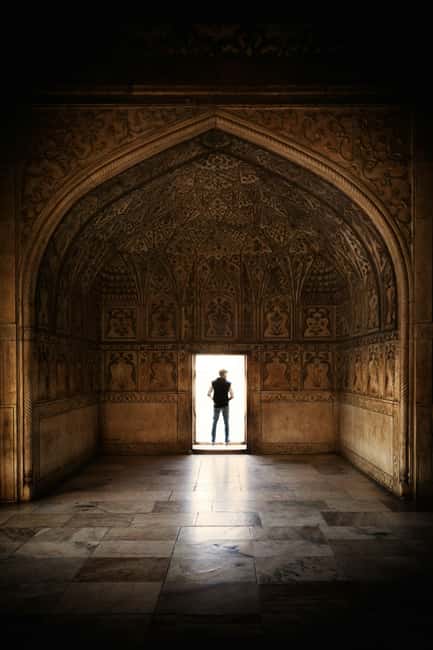
Next, the tour guides you toward Musamman Burj, where Shah Jahan spent his final days gazing toward the Taj Mahal, according to the tour’s framing. It’s a poignant stop because the story is both personal and imperial: power, downfall, and the shaping of legacy through architecture.
This is also where you’ll appreciate having someone interpret the space for you. Without context, you might treat it as just another viewpoint. With context, it becomes a place where you understand how rulers used visibility—what they could see, what they could command, and what they were denied.
You can also read our reviews of more guided tours in Agra





Mirrored palace and Anguri Bagh: geometry you can actually see
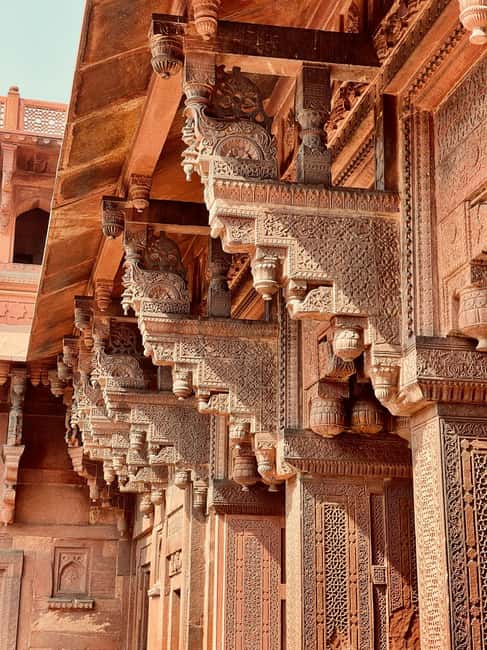
Then the tour moves from heavy story spaces to design pleasures. If the mirrored palace is accessible on your day, you’ll step into a room where reflections do the work of decoration. It’s the kind of feature that sounds gimmicky until you see it as part of the Mughal obsession with light, pattern, and visual effect.
After that, you’ll visit Anguri Bagh, the geometric gardens. The gardens are important because they show Mughal control of nature through layout. You’re not just looking at plants; you’re looking at proportion and structure—the idea that a royal garden is also a statement.
Photography helps here, too. If you like architectural shots, the garden grids and palace angles give you plenty to work with. If you like people-free landscapes, this part can deliver that quiet “clean frame” feeling—especially when you position yourself around the garden geometry.
Photo tips that your guide will help with
Agra Fort is a photo magnet. The trick is getting shots that don’t look like everyone else’s postcard. A major value of this tour is that guides like Gagan and Shahid Khan have real-world photo practice: they’ll take great pictures of you at good spots and steer you toward angles that match the story of each room.
There’s also a real safety and comfort benefit here. The guide approach includes watching out for pushy behavior around the entrance area—helping you avoid hassle from scammer-style photographers and vendors when you’re trying to get your bearings. That matters because Agra Fort’s surroundings can be a lot to process when you arrive hungry, hot, and jet-lagged.
One more practical note: photography is allowed, but drones and tripods are usually prohibited without special permission. Regular handheld photos are fine, so plan to travel light in terms of gear.
Pace and comfort: a big fort in one hour
This is a 1-hour experience, which means you’re not doing every corridor. You’re doing the key stops that give you the strongest understanding of the fort’s purpose and story.
The tradeoff is physical. The fort is huge, with uneven surfaces and plenty of walking. You’ll want comfortable shoes with grip. If your legs hate stairs, plan slower moments and let the guide keep you on the most manageable path.
Also, expect bag checks at the entrance. Keep your bag small, and avoid bringing large items you’d rather not carry through security.
Since this is a private group format, the pacing is usually easier to manage than a big group shuffle. That’s especially helpful if someone needs a slower rhythm or if you want a bit more time at a photo stop without derailing everything.
Price and value: why $6 makes sense (and when it doesn’t)
At about $6 per person for a guided walk, this is strong value—especially because Agra Fort is a complicated place to interpret on your own. Without a guide, you’ll see highlights. With a guide, you’ll understand what those highlights were for: courts, private rooms, imprisonment locations, and palace design choices.
The included part is simple: the guided tour of Agra Fort. Transfers aren’t included, so you’ll either handle local transport yourself or already be near the fort area. If you’re coming from farther out and need a car, your real cost may rise.
Still, as long as you can get to the meeting point area and you’re willing to do the walking, the guided hour is a smart way to maximize your day. It’s also a good fit if you’re pairing Agra Fort with the Taj Mahal, which is about 2.5 km away—close enough to handle in the same day with good planning.
Meeting your guide smoothly (WhatsApp helps)
One of the small things that can prevent a big travel headache is communication. You’ll receive the guide’s contact details one day before your tour via WhatsApp (or email if you don’t use WhatsApp). Your booking voucher also lists the local service provider’s WhatsApp number, so you can ask quick questions or coordinate if you’re delayed.
This is especially useful because entry areas can be confusing the first time. Having a direct line reduces the odds of losing time, and time is everything with a 1-hour tour.
Best for: who should book this
I’d put this tour at the top of your list if you:
- want a quick, story-driven way to understand Agra Fort without getting lost
- care about seeing the specific rooms that connect to major Mughal moments
- appreciate photo help and crowd-smart guidance at the entrance
- plan to visit the Taj Mahal the same day and want both framed properly
If you’re the type who hates structured routes and wants maximum freedom to roam for hours, you might feel constrained by the 1-hour focus. But if you want a solid “greatest hits + real meaning” visit, the time limit works in your favor.
Should you book the Agra Fort guided UNESCO walking tour?
Yes, if your goal is to leave Agra Fort with understanding, not just snapshots. For a low per-person price, you get a guided walk through the fort’s most important audience and palace spaces—plus the prison and final-days storyline tied to Shah Jahan, and the mirrored palace and garden geometry moments.
Also, the guide quality cues are real: people highlight clear communication (including meeting on time), patient pacing, photo assistance, and help avoiding vendor hassle. In a place where timing and navigating matter, that’s worth something.
Skip it only if you want a long self-paced explore, or if you know you won’t handle uneven walking surfaces comfortably. Otherwise, this is one of the better ways to turn an iconic fort into a memorable, organized experience.
FAQ
How long is the Agra Fort guided tour?
The tour lasts 1 hour.
Where do I meet my guide?
You’ll receive the guide’s contact details from the local service provider one day before your tour via WhatsApp (or by email if you don’t use WhatsApp). The WhatsApp number is also listed on your booking voucher.
What’s the price of the tour?
The price is $6 per person.
What’s included in the price?
The tour includes a guided tour of Agra Fort.
Are transfers included?
No, transfers are not included.
What languages are the tour guide available in?
The live tour guide is available in English and Hindi.
What should I bring?
Bring comfortable shoes and a camera.
Is photography allowed?
Photography is allowed, but drones and tripods are usually prohibited without special permission.
Is the tour private?
Yes, it’s listed as a private group experience.